


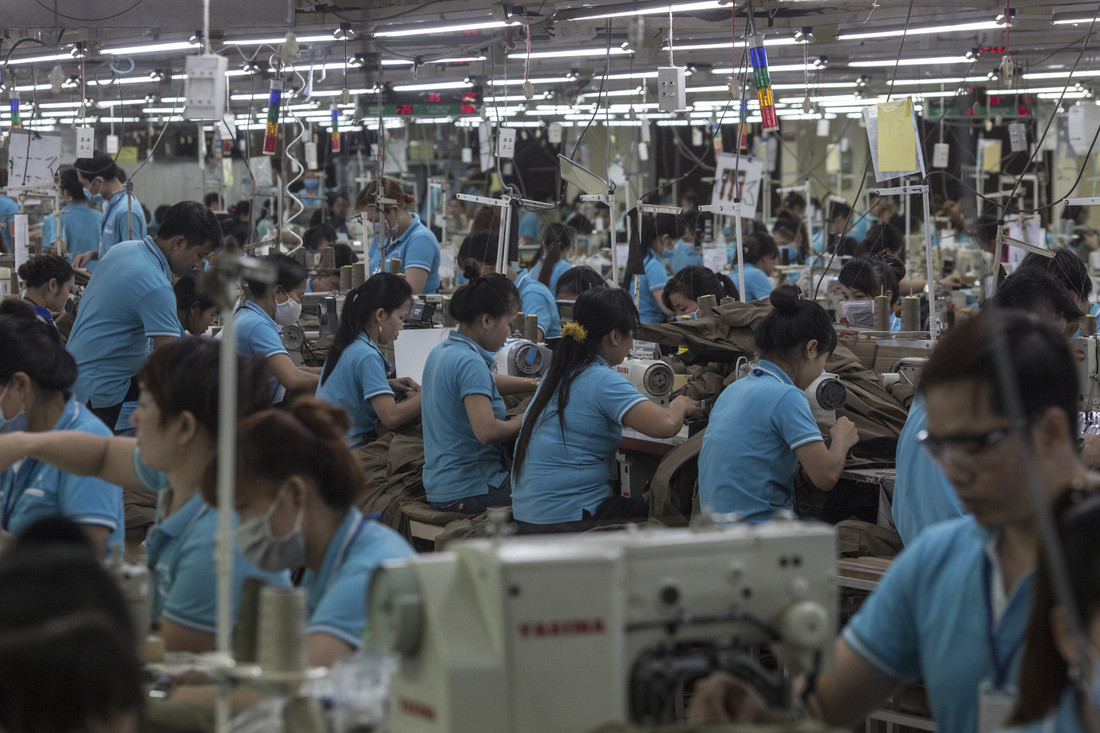
Line-workers make trousers and jackets for international brands at a garment factory in Dong Nai province, Vietnam, on November 21, 2017.
According to the Forbes World’s Billionaires List 2017, eleven of the world’s fifty wealthiest people are linked to the fashion and retail industry. Some of world’s biggest fashion brands source their clothes from countries where labour is cheap, such as Vietnam. The world’s five biggest garment companies payed their owners a total of $6.9 billion in 2016. One third of that amount would be enough to ensure a living wage for each garment worker in Vietnam.
In 2015, Vietnam was the fourth-largest garment exporting country in the world, after China, India and Bangladesh. Exports go mainly to the United States (47 per cent of total export value), Europe (16 per cent) and East Asian countries including Japan and South Korea.
The human cost is high. Employees at garment factories work six days a week, often at less than USD$1 per hour. Workers are under pressure to meet daily targets and end up working longer hours with barely any breaks or leave. Yet while billionaires are enjoying a bumper growth in their fortunes, the world's poorest women work long days with barely a break and still struggle to earn enough to feed their families. On average, it takes approximately 11 days for a CEO from the top five companies in the garment sector to earn what an ordinary worker earns in their lifetime in Vietnam.
In Vietnam millions of people move from rural to urban areas to find better paid work to support themselves and their family. About 35% of female migrants end up working in the processing and manufacturing companies, such as garment factories. While they work in the same pressured conditions and for the same minimum wage as others, migrants are often charged twice as much for basic services such as electricity and clean water.
Over half of migrant workers travel alone, leaving their children and families in their hometown, with the majority travelling hundreds of kilometres from home in search of better paid employment. Migrants send on average almost a quarter of their income to their families, who remained in the countryside. Because of minimum wages, many can’t afford the journey home for themselves and end up not seeing their own children for months or even years.